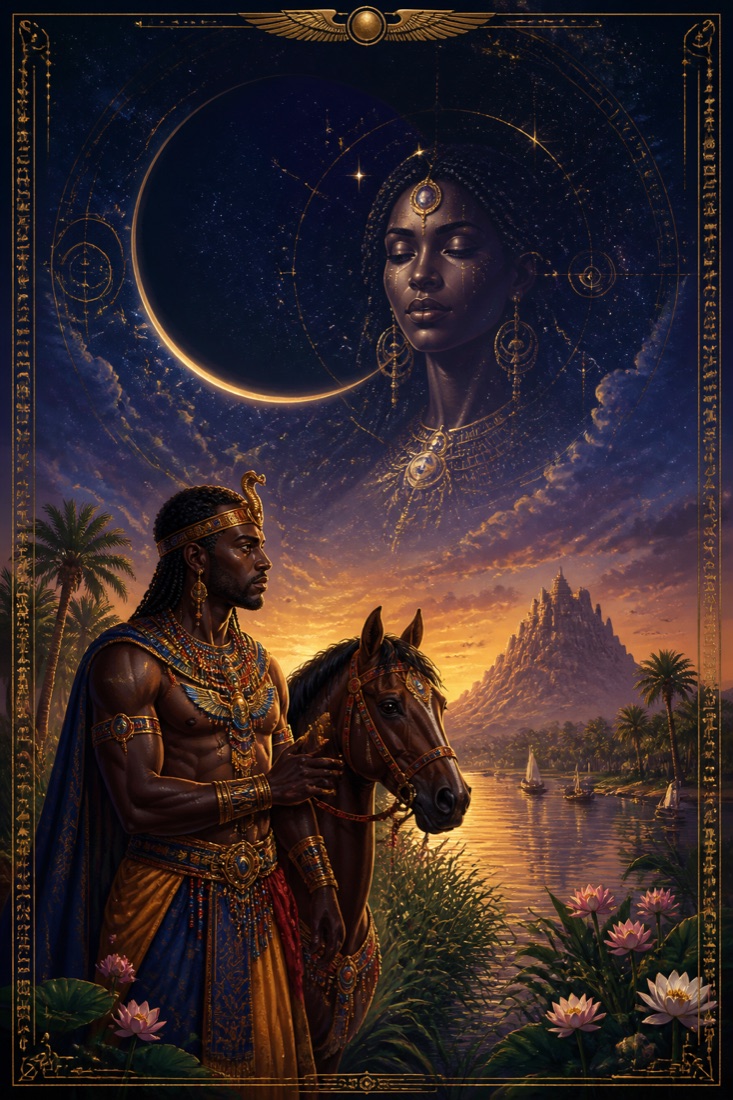
Five kingdoms. One river. One hidden Messenger — and 390 cards that make African civilizations playable, collectible, and unforgettable.

Not five themed decks — one educational mythology engine. Five complete tarot decks of 78 cards each (390 total), one per kingdom, sharing a single spine: the same 22 archetypes, the same four forces, the same court. A card drawn in one kingdom rhymes with its sister in another. That shared spine powers a strategy card game where matching across kingdoms is how you win — and it lets all five decks be read side by side as a single oracle.
The decks don't differ by costume — they differ by worldview. Each is grounded in a real kingdom, its own faith, its own material world.
Order · Survival · Connection · Custodianship · the Spoken Word. One cosmos, five shores.
One bird wears five forms — falcon, soapstone eagle, rainbow serpent, winged lion, praise-bird — and it is hidden somewhere in all 390 cards. It witnesses every card, recording the movement of destiny through the kingdoms.
Its visibility is a secret language players learn without being told — and teach each other. A puzzle hunt living inside an oracle.

Because every card's meaning is fixed while its face changes, you can lay the same archetype from two kingdoms — the Emperor of Kush beside the Emperor of Zimbabwe — and read one throne seen twice. Piye's righteous order beside Shaka's terrible order turns “authority” into a question about what power is for. That's a Confluence.
Match the same suit-and-number across kingdoms and you have a Current — the same human force surfacing across centuries. The object changes; the current does not.
This is comparative mythology you can hold in your hands — and the engine of both the readings and the game.
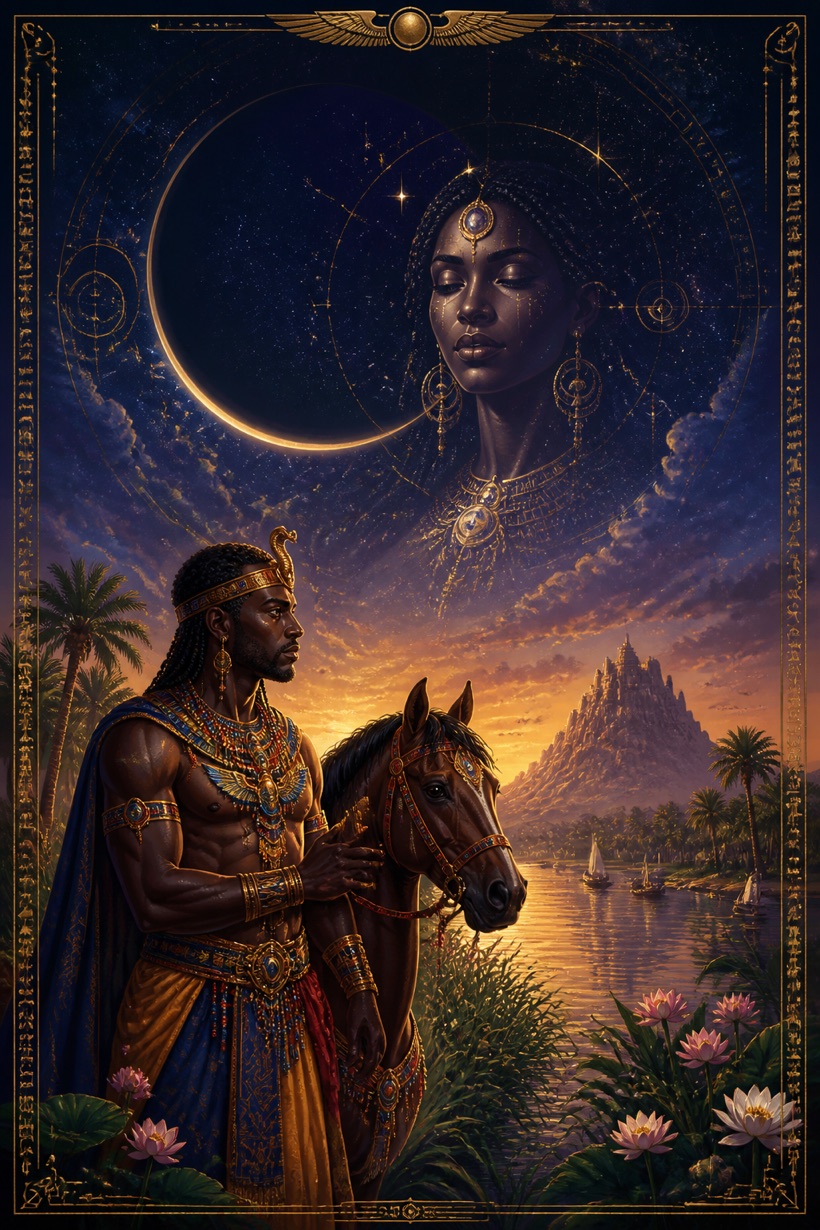
2–5 players, one kingdom each — easy to teach, deep to master. You build a shared River of currents and confluences, and race to bring the Messenger home. Every game is also a reading.
Take one kingdom deck each — or deal from a shared shuffle of all five. Majors and Minors shuffle together thanks to the one shared card back. Deal 7.
A central row is The River. On your turn, draw one and play one — laying cards left to right into runs and pairs.
Continue a suit-run already in the River with the next number — the element running strong through time. +1 each.
Play a Major matching an archetype already in the River from a different kingdom. +3, and both go to your ancestor pile.
Play The Star / Messenger to copy any archetype in the River as a wild — or to steal a Confluence out from under a rival.
The Devil archetypes carry a penalty if left in your hand at the end — the god-king you couldn't put down.
Complete The World in your own kingdom while holding the Bird. It ends the round and scores double — the messenger that, across the whole saga, is always trying to come home, finally placed home.
Three layers run at once. A child won't set out to learn comparative African philosophy — they'll set out to be Makeda, or Sundiata, or Piye, and realize years later they learned it along the way.
A child sees a queen, a lion, a river, a star — and wants to hold it. Museum-grade art is the doorway in.
Currents and kingdoms interact. Players learn strategy — and start asking who these people really were.
Through play, they absorb that African civilizations were diverse, held distinct philosophies, and solved the same human problems differently — producing heroes, laws, art, and cosmologies.
Heroes, not trauma. The historical tragedies are present as weather — never as the protagonist. Beauty is the doorway into complexity.
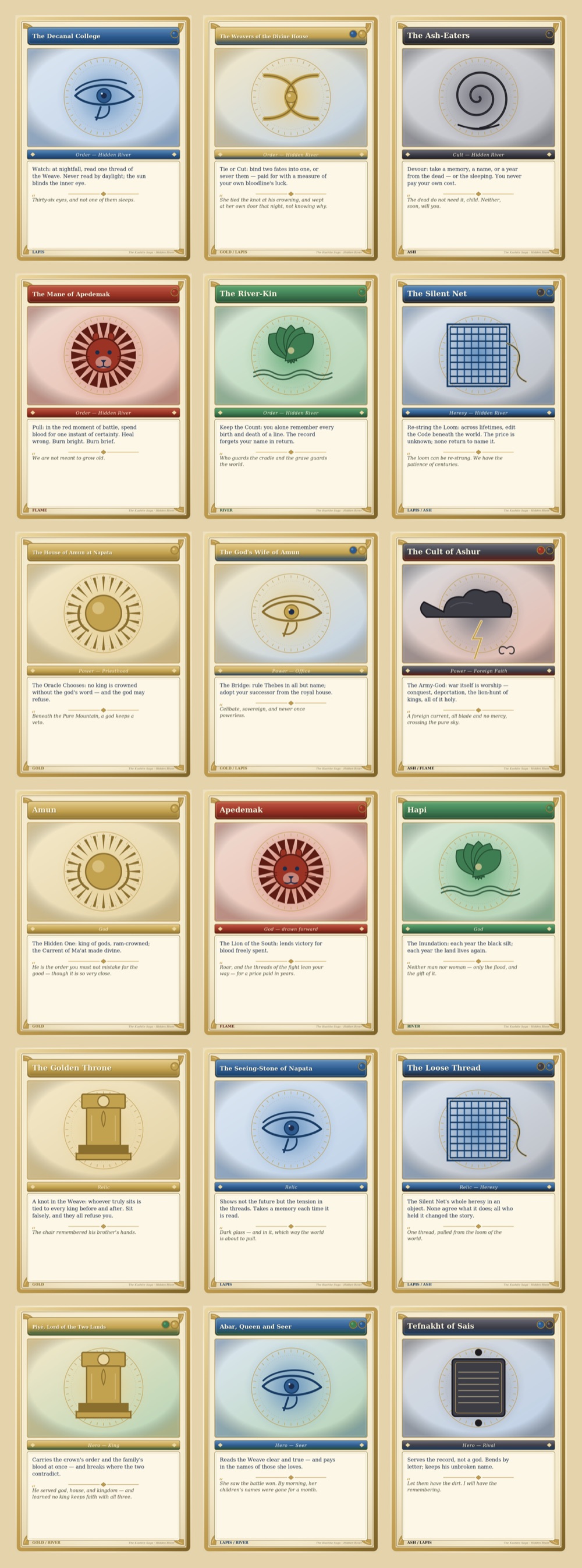
Beneath the tarot runs a second layer — the deep lore of the Kushite Saga, and an advanced faction game built on it. Not five kingdoms but one, read all the way down: five Currents that answer a single question — what holds the world together? They are not good and evil. They sit in a ring, each allied to its neighbors and opposed to those across from it.
Order, duty, legitimacy. The world is held together by the rightness of things — and someone must carry it.
Knowledge and foresight. The world is held together by pattern — and to see the pattern is to be responsible for it.
Honesty about death, and the will to pay any price. Nothing is held together — only paid for.
Courage, passion, loyalty. The world is held together by blood freely spent — the warrior's, the mother's, the sacrifice's.
Life, fertility, the long memory of the family. The world is held together by kinship — the dead are not gone.
The Hour-Watchers — temple astronomers who keep the 36 star-clocks and, quietly, read the Weave for the crown.
The hidden circle around the God's Wife of Amun — royal women who don't just read the Weave, they tie it.
The hooded cult of the Devourer. They refuse to pay their own time — they eat the residue of the dead, and lately the living.
Warrior-mystics of the lion-god who burn through the Weave — trading blood for an instant of impossible certainty.
Midwives, embalmers, keepers of family memory — the least secret and most underestimated order. They keep the count of the dead.
Not a temple — a belief hiding inside the others: that the loom beneath the world can be re-strung. Patient past any single life.
Every act of Seeing is paid for — in time, memory, years, the body. The first law of the Hidden River: nothing is shown for free.
Eighteen finished cards from the Hidden River set — each keyed to its Current, with a power and a line of flavor. The full deck plays as a faction war beneath the tarot's five shores.

The Hidden River set · designed cards for the Kushite deck.
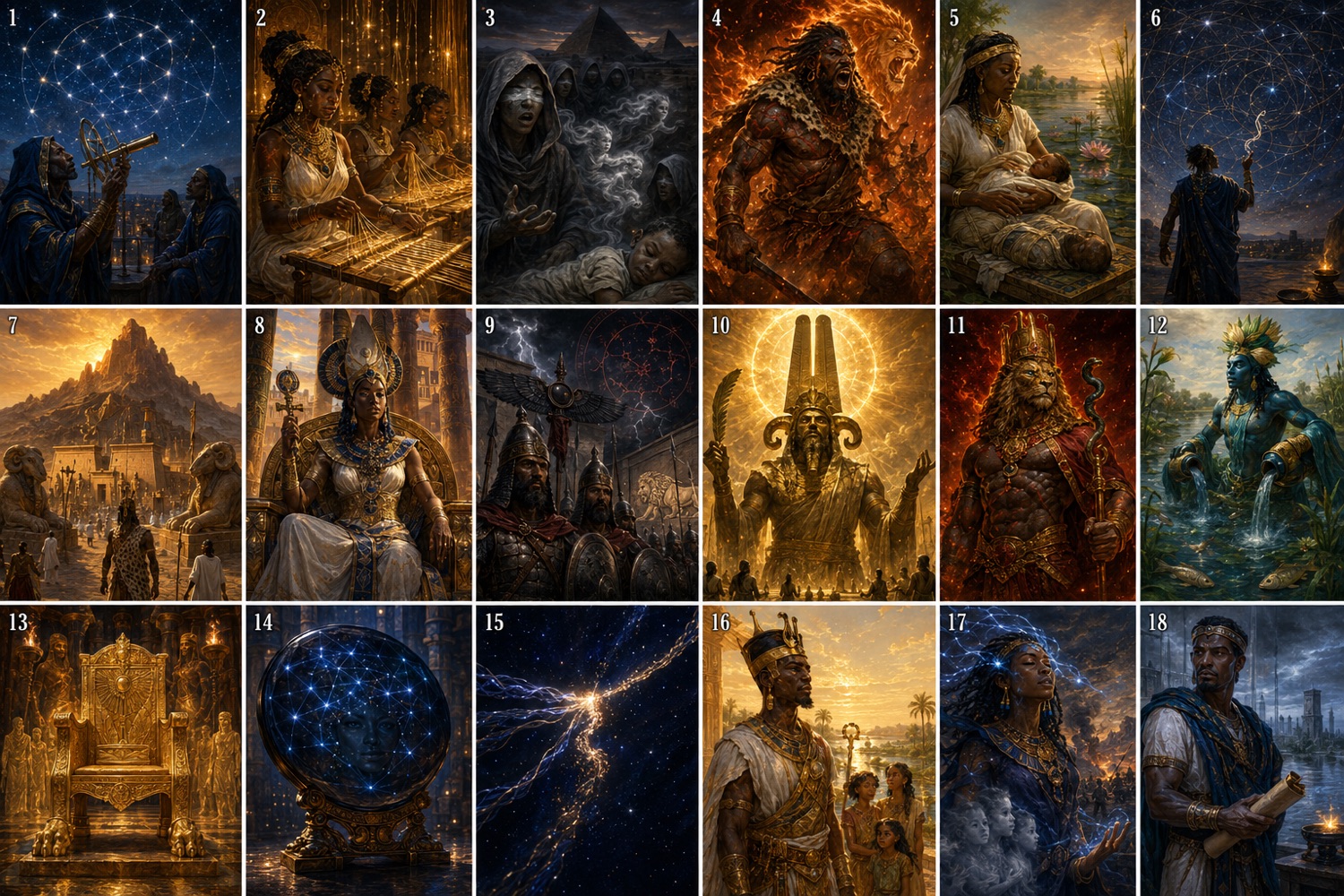
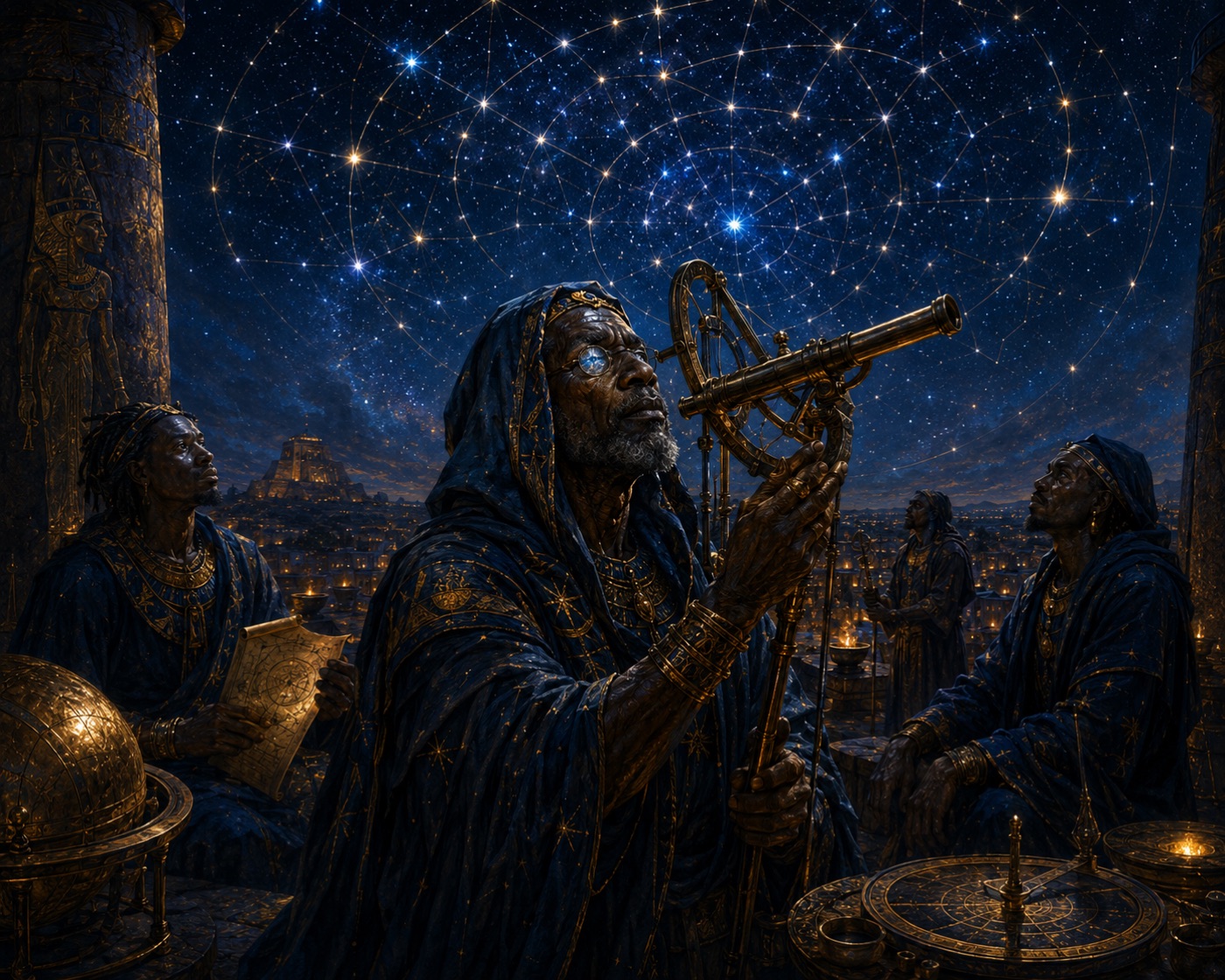
Painterly, museum-grade African mythic art — the gravity of a fresco, the gold of an illuminated manuscript, held together by eight Laws of Coherence so all 390 cards feel discovered in one lost archive.

Sample renderings — the Kush deck's Major Arcana. One shared gold border; a hidden Messenger in every card.
Master system, five kingdom guidebooks, the full art & prompt bible, all five kingdoms' Major Arcana prompt sheets, and Kush's complete Minor Arcana — complete. The one-page pitch is enclosed.
The pitch PDF is password-protected · your password arrived with this link. — Niia Bishop